The Deschutes Basin Irrigation Districts
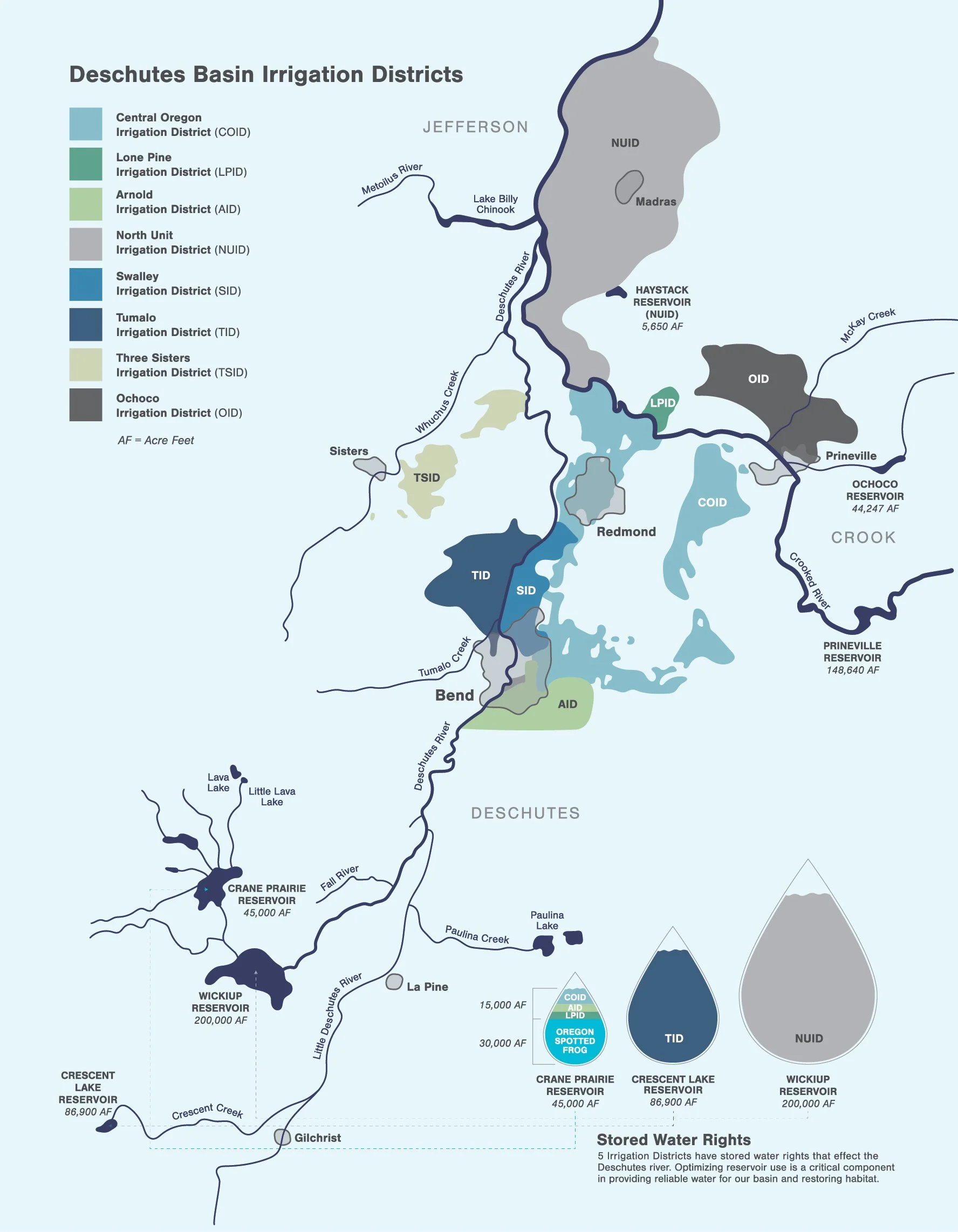
There are 8 Irrigation Districts in Central Oregon’s Deschutes Basin - and each one has its own characteristics.
If you’re dreaming of owning land in Central Oregon—whether it’s a hobby farm in Tumalo, a hay field in Terrebonne, a market garden near Redmond, or a few peaceful acres outside Bend—water matters just as much as the soil beneath your boots. And in the Deschutes Basin, water isn’t just about wells and rainfall. It’s also about irrigation districts.
There are eight irrigation districts in the Deschutes Basin, and surprisingly few buyers understand how much the district alone can affect their property’s value, reliability of water, and long term use potential.
In this guide, I’m breaking down:
What irrigation districts are and how they work
Why they matter when buying rural or farm property
A brief history of water rights and the “prior appropriation” system
A plain-English overview of the eight districts
What modernizing irrigation might mean for Central Oregon’s future
If you’re buying rural property in Central Oregon, this article will save you time, confusion, and expensive regrets.
Why Irrigation Districts Matter When You’re Buying Land
Most people understand wells and septic systems. Irrigation districts? Not so much.
But in Central Oregon, your irrigation district can determine:
Whether your water rights are reliable or frequently curtailed
Your annual assessments and fees
The quality and pressure of water delivered
Whether your property will have water during drought years
How your land can legally be used
Two properties with identical acreage, identical zoning, and identical soil can have wildly different values depending on which irrigation district serves them and how senior their water rights are.
It’s not just farmers who should care either.
Homesteaders, equestrian owners, gardeners, and anyone dreaming of a green oasis in high desert country should understand this system before making a purchase.
What Is an Irrigation District?
(Plain English Version)
An irrigation district is a public entity that:
Diverts water from rivers or reservoirs
Maintains canals and piping
Delivers irrigation water to landowners
Collects annual fees from patrons (property owners)
When you buy land with water rights, you automatically become a patron of that irrigation district. You pay annual assessments whether you use water or not.
Think of irrigation districts like rural utilities—except instead of electricity or sewer, they manage water that dates back over a century.
A (Very Brief) History of Water Rights in Oregon: Prior Appropriation
Most people are shocked to learn that Oregon does NOT use the same water system as much of the eastern U.S.
Out here, we follow something called Prior Appropriation, which boils down to:
“First in time, first in right.”
That means the earliest water right holders get water first. If water runs out, junior right holders get cut off.
Priority dates often go back to:
The late 1800s
Early settler claims
Railroad-era diversion projects
Depression-era federal infrastructure builds
So when you hear someone talk about “senior” water rights, they don’t mean respect—they mean priority status during shortage years.
The Eight Irrigation Districts in the Deschutes Basin
Each of these districts operates independently. They differ in:
Infrastructure quality
Water reliability
Assessment costs
Access to reservoirs
Modernization progress
Here’s a practical overview of each one:
Central Oregon Irrigation District (COID)
Serves: Bend and surrounding areas
Notes: One of the largest districts. Known for major canal piping projects through Bend. One of the best for senior water rights.
COID has invested heavily in piping canals over the years to reduce water loss via evaporation and seepage, which drastically improve efficiency. Reliability varies by location and water right priority, but overall this district is leading the charge on progress.
Tumalo Irrigation District (TID)
Serves: Tumalo area
Notes: Strongly community driven and innovative. Seasonal water users.
Tumalo leans smaller and more agricultural. It tends to attract homesteaders and lifestyle farmers. Seasonal delivery means water is turned off in winter.
Arnold Irrigation District
Serves: Southeast Bend, Alfalfa area
Notes: One of the oldest districts. Heavy reliance on aging open canals.
Arnold struggles more than most with aging infrastructure and limited funding. Buyers should carefully check delivery history and reliability, as some patrons have had their water delivery cut off in late July… not ideal for any kind of growing operation. There is hope however, with Avion (a local private Water Company) investing in piping canals and offering additional water delivery methods.
Lone Pine Irrigation District
Serves: Alfalfa area
Notes: Small, older district with limited supply.
Lone Pine’s water rights are often among the most restricted during drought. Properties here may require alternative water strategies (wells or cisterns) to supplement.
North Unit Irrigation District (NUID)
Serves: Madras, Terrebonne, Culver
Notes: One of the largest yet limited districts.
North Unit serves some our largest cattle and comodity crop farmers, yet their water is often limited each year. Some farmers report only receiving 1/8 of the water they are actually allocated. This is largely due to the fact that the water has to travel over 50 miles through hand dug canals to even reach the district, loosing valuable quantities to evaporation and seepage. Efforts to add reservoirs have helped to combat this, but full transparency, it’s tough out there. Farmers have had to adapt growing and irrigation methods to make their water stretch.
Swalley Irrigation District
Serves: Redmond area
Notes: One of Central Oregon’s oldest and most respected districts. Actively modernizing with strong reliability.
Swalley Irrigation District is known for forward-thinking infrastructure improvements, including extensive canal piping and efficiency upgrades. These projects help reduce water loss, improve delivery pressure, and increase reliability even during lower snowpack years. Buyers in the Redmond area often seek out properties within Swalley because of its relatively strong water certainty compared to some neighboring districts.
Ochoco Irrigation District
Serves: Prineville region
Notes: Tied closely to Ochoco Reservoir’s capacity levels.
A wetter district by Central Oregon standards. System reliability strongly tracks reservoir snowpack and refill levels.
Three Sisters Irrigation District (TSID)
Serves: Sisters area
Notes: Known for early modernization.
TSID was ahead of the curve with piping canals decades ago. Higher reliability due to reduced leakage and more controlled delivery.
Senior vs Junior Rights—What Actually Matters to Buyers
Your water right’s priority date matters even more than the district itself.
Here’s how it plays out in real life:
Senior rights usually receive full water during dry years
Junior rights may face reductions, rotation schedules, or full shutoffs
Most district users do not receive guaranteed volume—only access
This is why two neighbors can experience very different irrigation reliability on the same canal.
Common Buyer Mistakes With Water Rights
Here’s where I see people get burned:
1. Assuming land = water
Not all acreage includes irrigation rights.
2. Ignoring district assessments
Annual fees can range from modest to painful.
3. Not checking delivery history
Some districts experience routine shortages.
4. Confusing irrigation rights with wells
These are separate systems governed by different rules.
5. Overestimating acreage coverage
Some properties only have rights on a portion of the land.
An Opinion Worth Saying:
Prior Appropriation Is Outdated
The prior appropriation doctrine made sense in the 1800s.
Today? It creates problem after problem.
We are now trying to manage:
Modern cities
Climate instability
Groundwater depletion
Habitat protection
Agricultural expansion
…using a legal framework built for horse wagons and gold miners.
The system:
Rewards historical use, not responsible use
Discourages conservation
Penalizes new farmers
Limits water flexibility
Blocks innovation through rigidity
Modernization Could Mean:
Water banking systems to support dry-year transfers
Efficiency credits for landowners who upgrade infrastructure
Dynamic allocation models instead of century-old priority lines
Inter-district flow balancing
Water reuse and recycling programs
Climate responsive policy models
None of this means dismantling the system overnight—but without reform, Central Oregon’s agricultural future becomes increasingly brittle.
Why This Matters for Buyers Right Now
Central Oregon is changing.
The people buying rural property today:
Aren’t all commodity farmers
Want diversified income
Care about sustainability
Expect infrastructure to evolve
Are long-term land stewards
Understanding irrigation isn’t optional anymore—it’s a core part of buying intelligently.
Final Thoughts
If you’re looking at rural property in the Deschutes Basin, ask these questions early:
Which irrigation district serves the land?
What’s the priority date?
Have curtailments happened before?
What modernization is underway?
How much are yearly assessments?
Is irrigation supplemental or essential for your use?
Water is not just a feature—it’s a foundation.
And knowing how Central Oregon’s irrigation system works puts you ahead of most buyers before you ever make an offer.
If you’d like help reviewing irrigation districts when you’re evaluating properties—or want a second set of eyes on water rights language in a listing—reach out anytime.
I’m always happy to talk dirt, water, and land.
Pop over to the contact page or tap “Get Started” in the top right corner to connect!